
Your Journey to an AI-Operated Business
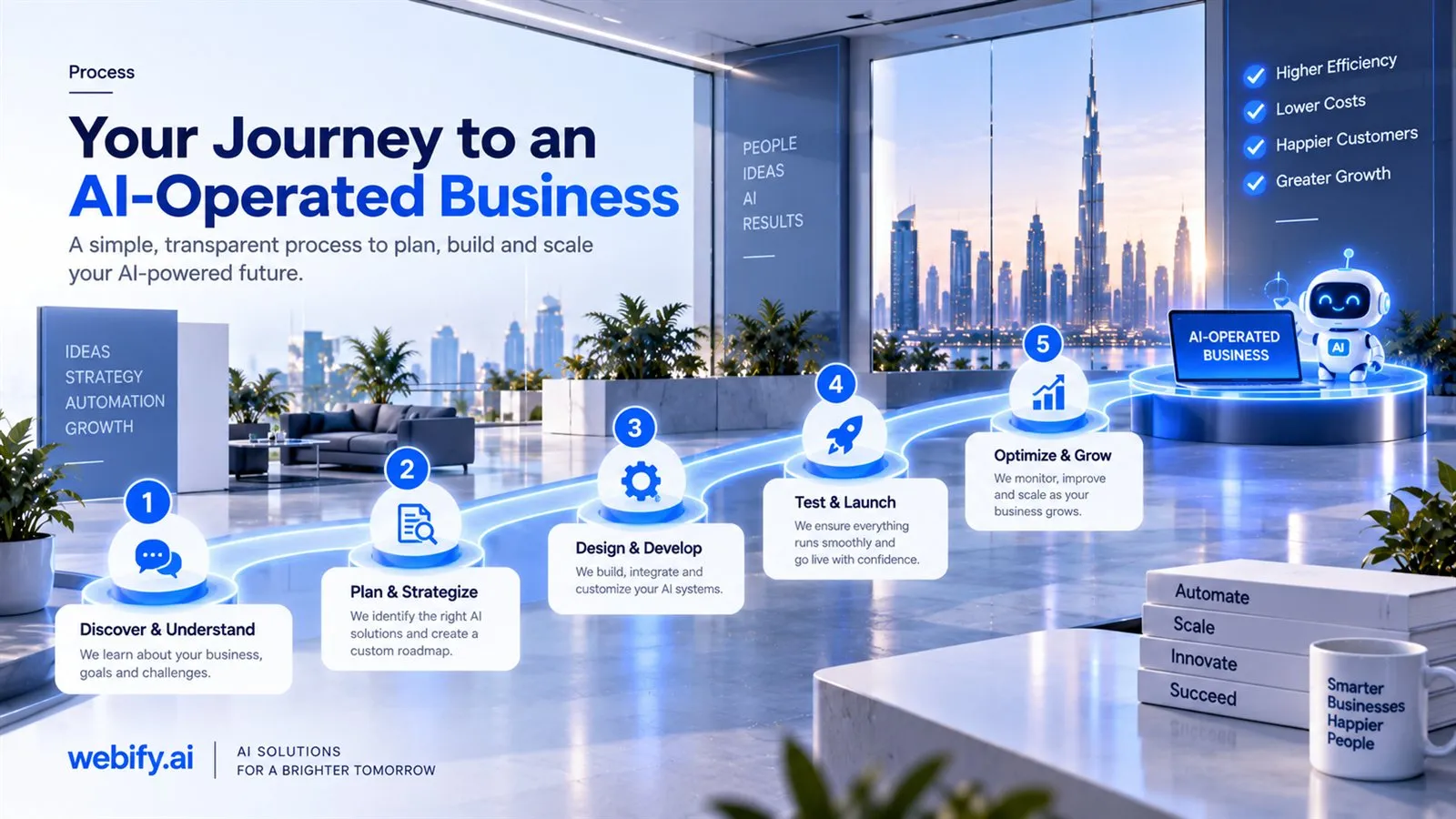
Book Discovery Call
Align on goals, systems and constraints.
Identify Opportunities
Map highest-ROI automation candidates.
Custom AI Roadmap
Phased plan with KPIs and timelines.
Deploy Pilot Agent
Ship a production agent in weeks.
Scale Across Departments
Expand the AI workforce company-wide.
Book Discovery Call
Align on goals, systems and constraints.
Book Discovery Call
Align on goals, systems and constraints.
Identify Opportunities
Map highest-ROI automation candidates.
Custom AI Roadmap
Phased plan with KPIs and timelines.
Deploy Pilot Agent
Ship a production agent in weeks.
Scale Across Departments
Expand the AI workforce company-wide.
How does Webify.AI deliver an AI project?
In six steps, each with a decision point. We agree in writing what success looks like before we build, prove it on one workflow with your own data, and only then move to production. At every step you can change scope or stop, and what we have built so far is yours.
- 1
Free first call
Your goals, systems and constraints, and a straight answer on whether AI is the right tool for the job.
- 2
Discovery
We map candidate workflows, check your data, systems and access, and pick one with clear right and wrong answers to start.
- 3
Written success criteria
Before any build: the accuracy to reach on a test set of your real requests, the response time, and who reviews the outputs.
- 4
Pilot on one workflow
Built in your accounts and repositories, on your own data, with the tools and permissions the agent needs and no more.
- 5
Evaluate and decide
We run the test set and report the scores, including the failures. You choose: production, a change of scope, or a stop.
- 6
Production and handover
Integrations, guardrails, human approval for risky actions, logging and monitoring, then documentation and a runbook for your team.
Why written criteria matter: MIT research reported by Fortune found that about 95% of enterprise generative AI pilots produce little measurable profit impact (Fortune). A pilot without an agreed finish line is hard to judge, so ours always has one.
How long does a first AI agent take to build?
A first agent scoped to one task with one or two system integrations typically takes six to twelve weeks from discovery to production. Discovery takes days, a working prototype a few weeks, and piloting and hardening a few more. Access to your systems and data usually decides the pace.
These are typical ranges, not promises. Private AI pilots on your own hardware run two to four weeks after discovery; the private AI page sets out that ladder and its prices. Adapting a pre-trained agent from the Bot Store can be quicker than a new build. Our guide on how long an AI agent takes to build covers each stage, and what it costs is set out separately.
What do you test before an AI agent goes live?
Answers, actions and failure paths. The agent is scored against a test set of real requests, tried with hostile inputs such as prompt injection, and checked to hand over cleanly when it cannot help. The same test set is re-run after every change to a prompt, a model or a tool.
- Accuracy against the agreed test set, with the failures reported, not hidden.
- Limits: narrow tools, least-privilege accounts, validated inputs, spending and rate limits.
- Human approval for consequential actions, such as refunds or outbound messages.
- Handover: the conversation, what the agent tried and what it found go to a person.
- Logs of every action, so you can see what the agent did and why.
What do you own at the end of the project?
Everything we build for you. The code, prompts, test sets and configuration live in your repositories, the IP is assigned to you in the contract, and model and cloud accounts are in your company's name. Any engineer, ours or yours, can carry the work on.
Ending the engagement does not affect your ownership. The contract terms, and the questions to ask any provider, are on our security page. Our guide to who owns the IP in outsourced AI work explains what to check in any contract.
How do we work with your team during the build?
As part of it. Named engineers join your stand-ups, work in your tickets and chat, and commit to your repositories. UK teams get 09:00 to 13:00 UK time every working day, inside a normal Indian working day, at no extra cost. US teams get 09:00 to 12:00 US Eastern time through an evening shift, at 15% extra.
Expect a short written update at the end of each Indian working day and a demo every week. If you would rather steer the work yourself, hire the engineers by the hour instead: see hire AI engineers. Our guide to working across time zones with an Indian team covers the daily routine, and how a two-week trial works covers the start.
Frequently asked questions
Is the first call free?
Yes. It is a conversation about your goals and systems, with a straight answer on whether AI fits. Paid work starts only after you have agreed a written scope.
Can we stop after the pilot?
Yes. The pilot ends with an evaluation report and a decision. If the results do not meet the agreed criteria, you can change the scope or stop, and you keep what was built.
Do you use our data to train models?
We don't. Agents answer from your documents through retrieval, inside your accounts. Fine-tuning is used only when evaluation shows a clear need, and the tuned weights stay in your environment. Whether a hosted model provider may train on your data depends on its terms and your account settings, which we check with you first.
Who maintains the system after handover?
Your team with the runbook, or our engineers on an hourly plan or a retainer. Either way, the code and documentation are in your repositories.
Can you build an agent that runs without the internet?
Yes. For data that must stay inside your network we build on open-weight models on your own servers, air-gapped if needed. See private AI.