
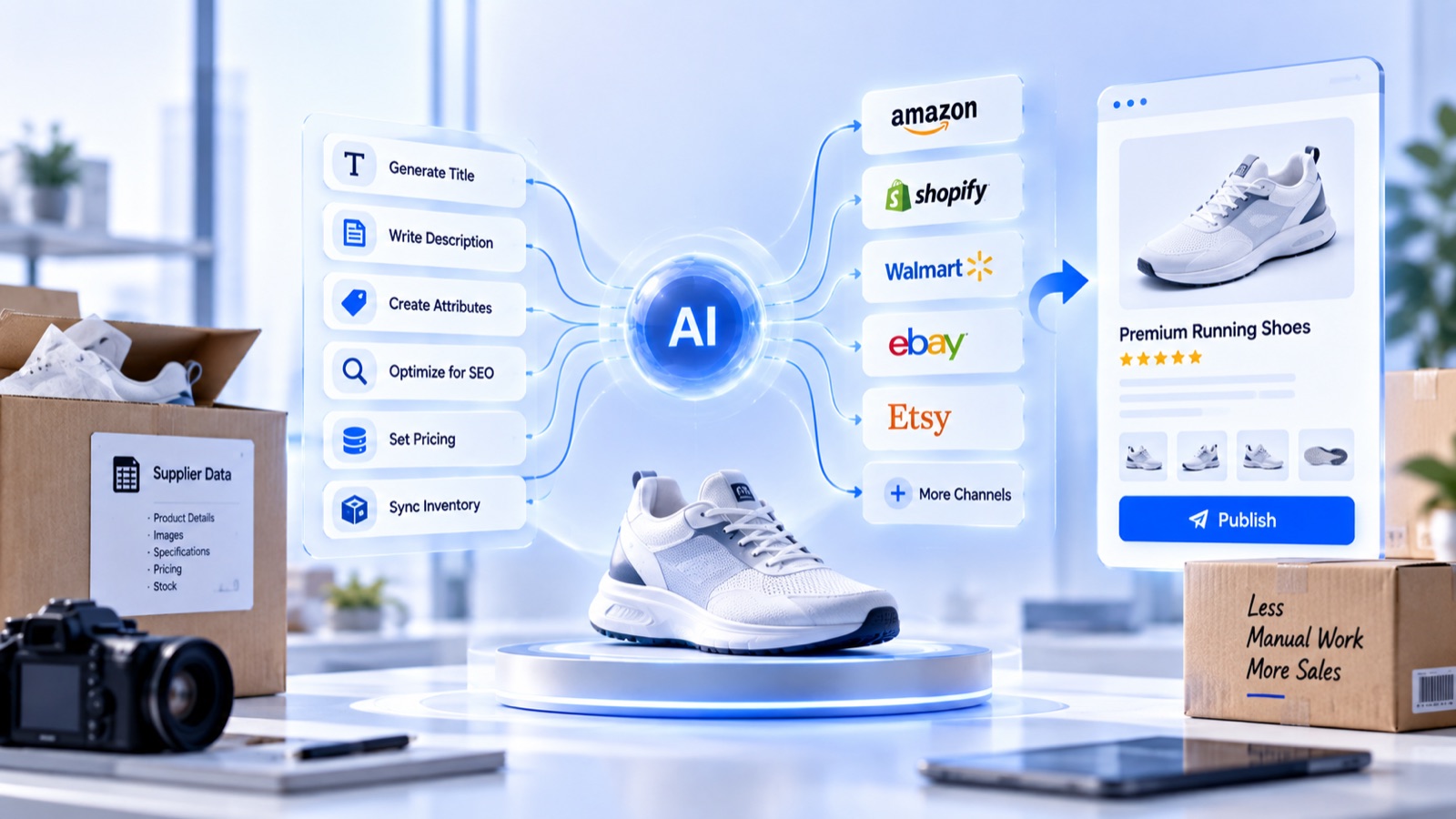
E-commerce Listing Automation with AI Agents
E-commerce listing automation uses an AI agent to generate, enrich and publish product listings across every sales channel automatically. It writes SEO-ready titles, bullet points, descriptions and attributes from raw supplier data, then syncs pricing and stock so catalogs stay accurate without manual data entry.
Updated
90%
less time spent on listing work
10x
SKUs published per person
40%
fewer listing rejections
Key facts
- Amazon limits product titles to 75 characters, including spaces, in every category except media from 27 July 2026, with a separate Item Highlights field of up to 125 characters.
- eBay titles allow 80 characters. Google Merchant Center allows 150, but shoppers usually notice only the first 70 or fewer.
- More than 900,000 Amazon sellers have used Amazon's free AI listing tools. Shopify's admin drafts AI descriptions one product at a time.
- ChatGPT and Google's AI Mode shop from structured product data that merchants supply.
- With Webify.AI, a catalog of a few thousand SKUs typically goes live in two to four weeks.
The problem today
- Copy-pasting the same product into Amazon, Shopify, eBay and marketplaces one channel at a time
- Inconsistent titles and attributes that fail marketplace validation or rank poorly in search
- Supplier feeds arriving as messy spreadsheets with missing sizes, materials and images
- Price and stock drift between channels causing oversells and account penalties
Outcome
Sellers cut listing time by up to 90% and scale catalogs from hundreds to thousands of SKUs without adding headcount.
Manual product listings across Amazon, Shopify and marketplaces drain hours every week and cause costly errors. Our AI agent auto-generates SEO-ready titles, descriptions and variants, then bulk-publishes across channels with inventory sync.
How it works
Ingest
Connect supplier feeds, ERP exports, PIM data or spreadsheets — the agent normalises attributes, units and categories.
Generate
The model writes channel-specific, keyword-optimised titles, bullets, descriptions and structured attributes for each SKU and variant.
Validate
Every listing is checked against each marketplace's category taxonomy, character limits and compliance rules before it goes live.
Publish & sync
Bulk-publish across channels and keep price, stock and content in continuous two-way sync.
What the agent does
Multi-channel publishing
Amazon, Shopify, Flipkart, eBay, Walmart, WooCommerce and custom storefronts from one source of truth.
SEO-ready copy at scale
Keyword-aware titles and descriptions generated per channel, per locale and per audience.
Variant intelligence
Automatic size, colour and bundle variant creation with correct parent-child relationships.
Image & media handling
Background clean-up, resizing and channel-specific media requirements applied automatically.
Amazon's 75-character title rule (2026)
From 27 July 2026, Amazon requires product titles of 75 characters or fewer, counting spaces, in every category except media. Detail that used to sit in a long title moves to a new Item Highlights field of up to 125 characters (Amazon Seller Central).
Titles still over the limit are being replaced gradually with an AI-written version that Amazon recommends. Brand owners get 14 days to review, edit or approve that recommendation before it takes effect.
For a catalog of thousands of products, that is a rewrite project. Every title has to shrink to 75 characters without losing the words shoppers search for, and the detail has to move into Item Highlights. The listing agent does it in bulk: it rewrites each title to the limit, writes the Item Highlights from the product's attributes, checks both against Amazon's rules and your keyword list, and queues them for your team to approve before anything changes on Amazon.
Title and description limits by channel
Each channel cuts or rejects listings at a different length. These are the current limits, from each platform's own documentation:
Swipe the table sideways to see every column.
| Channel | Title | Other fields | Source |
|---|---|---|---|
| Amazon | 75 characters including spaces, every category except media, from 27 July 2026 | Item Highlights up to 125 characters | Amazon |
| eBay | 80 characters | Subtitle up to 55 characters | eBay, eBay developers |
| Google Merchant Center | Up to 150 characters; shoppers usually notice only the first 70 or fewer | Description up to 5,000 characters | Google title, Google description |
Walmart, Flipkart and other marketplaces publish their own limits in their seller portals. The agent stores each channel's rules as settings, so when a platform changes them, as Amazon did this year, the update is a configuration change rather than a manual rewrite.
Free built-in AI tools or a listing agent?
Amazon and Shopify both include AI writing tools. Amazon says more than 900,000 selling partners have used its generative AI listing tools, and that they accept the content with little or no editing about 90% of the time (About Amazon). Shopify's admin drafts a product description with AI for one product at a time, and many of its AI features cost nothing extra, though availability varies by plan (Shopify, Shopify AI features).
If you sell on one channel and can work through your catalog product by product, these tools are often enough, and we will say so. A listing agent pays for itself when:
- You sell on several channels, and each needs its own title length, attributes and category.
- Products arrive as supplier spreadsheets or ERP exports, not one at a time.
- You manage thousands of SKUs, or variants that need correct parent and child relationships.
- Every listing must pass each marketplace's validation before it goes live, and price and stock must stay in sync across channels.
- You need the same catalog as product feeds for Google and ChatGPT, or in more than one language.
If you would rather have engineers build and run this with you, see hire an AI development team for retail automation.
Getting products into AI shopping: ChatGPT and Google
Shoppers now ask AI assistants what to buy, and the assistants answer from product data that merchants supply. OpenAI lets merchants send ChatGPT a regularly refreshed product feed, in CSV or JSON, with identifiers, descriptions, pricing, inventory, media and fulfilment options. The required fields cover price and availability, and richer attributes improve ranking (OpenAI).
Google announced the Universal Commerce Protocol on 11 January 2026, developed with Shopify, Etsy, Wayfair, Target and Walmart, and said it would use it for eligible product listings in AI Mode in Search and the Gemini app, starting with US retailers (TechCrunch).
Both run on structured product data, which is what a listing agent produces. The agent generates the Google Merchant Center and ChatGPT product feeds from the same product record as your marketplace listings, so one change to a price, a stock level or a description reaches every channel and every assistant.
Talk to us about your catalog
Tell us which channels you sell on, roughly how many products you have and where the product data comes from today. On a free call we will tell you whether the free built-in tools are enough, or what an agent would take for your catalog.
Frequently asked questions
What is e-commerce listing automation?
It is the use of AI agents to create, enrich and publish product listings across multiple marketplaces automatically — replacing manual data entry with generated, validated and synced content.
Which marketplaces are supported?
Amazon, Shopify, eBay, Walmart, Flipkart, WooCommerce, BigCommerce and any platform with a public API or bulk-feed format. Custom connectors can be built for private systems.
Does Amazon's 75-character title limit apply to every category?
Every category except media, from 27 July 2026, and the 75 characters include spaces. Extra detail goes in the Item Highlights field, which takes up to 125 characters.
What happens to Amazon titles that are still over 75 characters?
Amazon is replacing them gradually with AI-written titles it recommends. Brand owners get 14 days to review, edit or approve the recommendation before it takes effect. Rewriting the titles yourself first keeps your keywords under your control.
Is Amazon's or Shopify's free AI listing tool enough?
For one channel and a catalog you can edit product by product, often yes. An agent pays off when you list on several channels, start from supplier spreadsheets, manage thousands of SKUs or variants, or need validated, synced listings and AI-shopping feeds from one source.
Can it bulk upload the same products to Amazon, Shopify and eBay?
Yes. One product record produces a listing for each channel, with that channel's title length, attributes and category. Each listing is validated before it is published, and price and stock stay in sync afterwards.
How do I get my products recommended by ChatGPT and Google AI Mode?
Both work from structured product data. OpenAI accepts merchant product feeds for ChatGPT, and Google uses Merchant Center data and its Universal Commerce Protocol. Complete attributes, accurate stock and clear titles are what they read, and the agent generates those feeds from the same data as your marketplace listings.
Will AI-generated listings hurt my SEO?
No. Listings are generated against your target keywords and each channel's ranking rules, then reviewed against duplicate-content checks, which usually improves visibility versus copy-pasted supplier text.
How much does e-commerce listing automation cost?
It depends on the number of channels, the size of the catalog and how messy the supplier data is. Built-in marketplace tools cost nothing but work one channel at a time, and listing software charges a monthly fee. A custom agent is a one-off build plus running costs. Webify.AI quotes after a free call and a look at a sample of your catalog.
Do I have to replace my PIM, ERP or Shopify store?
No. The agent reads from the systems you already use, such as supplier spreadsheets, ERP exports, a PIM or Shopify, and writes to your channels through their APIs or bulk-feed formats.
How long does implementation take?
A typical catalog of a few thousand SKUs goes live in two to four weeks, including data mapping, tone-of-voice training and channel validation.
Sources
- Amazon Seller Central: Updates to improve your product titles begin on July 27
- eBay: Optimizing your listings for Best Match
- eBay developers: Listing title
- Google Merchant Center: Title [title]
- Google Merchant Center: Description [description]
- About Amazon: generative AI tools for sellers
- Shopify Help Center: generating product descriptions
- Shopify Help Center: AI features in the Shopify admin
- OpenAI: Agentic Commerce key concepts
- TechCrunch: Google announces a new protocol to facilitate commerce using AI agents, 11 January 2026
Related use cases
AI Customer Support Agents
An AI customer support agent is a trained assistant that answers customer questions and completes service actions across chat, email, WhatsApp and voice. It is grounded in your help centre, CRM and past tickets, resolves most tier-1 requests instantly, and escalates the rest to a human with full context attached.
Read more about AI Customer Support AgentsInventory & Order Management
AI inventory and order management uses agents to watch stock levels across every channel in real time, forecast demand from sales history and seasonality, raise purchase orders before stock-outs occur, and reconcile ERP, POS and warehouse records automatically.
Read more about Inventory & Order ManagementWorkflow & Process Automation
AI workflow automation replaces manual back-office steps with agents that read documents and emails, extract structured data, apply your business rules, route approvals and update CRM or ERP systems — turning multi-day processes into minutes with a full audit trail.
Read more about Workflow & Process Automation