
Custom AI Agent Development Services
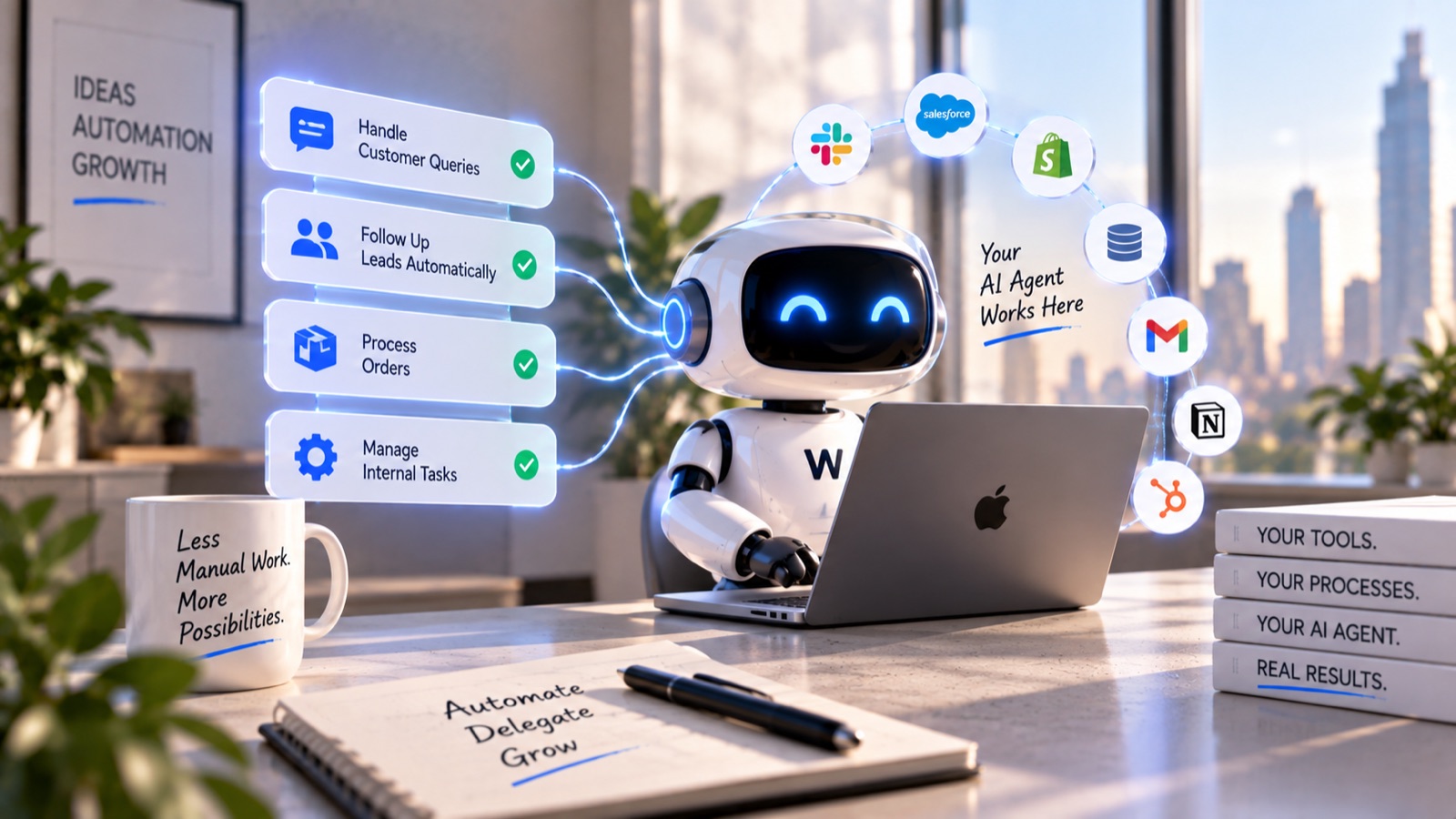
A custom automation AI agent is an autonomous assistant built around one of your business processes — support triage, lead follow-up, order handling or internal operations — trained on your own policies and connected to your existing tools so it can take real actions, not just answer questions. Human-in-the-loop escalation keeps ownership with your team.
AI agent development: agent types, where agents run, cost and timing
24/7
autonomous operation
6-12 wks
typical discovery to production for a first agent
1-2
systems connected in a typical first agent
The problem today
- Generic chatbots that answer questions but cannot complete a task
- Repetitive workflows depending on one person's availability
- Leads and tickets going cold outside business hours
- Automation rules too rigid to handle real-world variation in requests
Outcome
Businesses run support, follow-up and back-office workflows around the clock with agents trained on their own processes.
Tailored AI agents that automate repetitive workflows and integrate with your existing tools.
How we deliver it
Scope
One high-value workflow selected, with success metrics, guardrails and escalation rules defined.
Train
The agent is grounded in your SOPs, product data, tone of voice and historical conversations.
Connect
Tool access wired to CRM, helpdesk, database and internal APIs so the agent can act, not just reply.
Launch & tune
Shadow mode first, then supervised release, with weekly review of transcripts and outcomes.
What's included
Workflow automation
Multi-step tasks executed end to end with retries, logging and deterministic guardrails.
Tool & CRM integrations
HubSpot, Salesforce, Slack, Zendesk, databases and internal APIs available as agent actions.
Trained on your logic
Grounded in your SOPs, pricing rules and policies so answers reflect how you actually operate.
Human-in-the-loop
Confidence thresholds and approval steps route edge cases to a person with full context attached.
What you receive
- Workflow specification and guardrail policy
- Trained agent with grounded knowledge base
- Tool and CRM integrations with action logging
- Evaluation suite and transcript review dashboard
- Ongoing tuning and retraining plan
Frequently asked questions
How is an AI agent different from a chatbot?
A chatbot replies with information. An agent plans multi-step work and takes actions in your systems — updating a CRM record, issuing a refund, booking a slot — within guardrails you define.
What data is needed to train an agent?
SOPs, product and pricing information, policy documents and a sample of historical tickets or conversations. Two to three weeks of clean examples is usually enough to start.
How do you stop the agent making mistakes?
Deterministic guardrails on sensitive actions, confidence thresholds, approval steps for high-impact operations, full action logging and an evaluation suite run before every release.
Which systems can it integrate with?
HubSpot, Salesforce, Zoho, Zendesk, Freshdesk, Slack, Shopify, Google Workspace, Microsoft 365 and any internal system exposing an API.
Related services
Task Management System
A role-based work-assignment platform that connects executives, managers and employees with automatic alerts across WhatsApp, email and in-app channels.
Read more about Task Management SystemNews Automation Bot
AI-powered news aggregator that scrapes trusted sources and auto-publishes weekly, monthly and yearly summaries to your website.
Read more about News Automation BotAI Fashion Studio
Offline AI photoshoot generator that creates model-ready fashion images from a single product photo or dresses a model photo in your garment.
Read more about AI Fashion Studio